
Circle CEO Jeremy Allaire argued that USDC’s decade-long network of integrations, liquidity and regulatory infrastructure gives it a structural advantage over new stablecoin entrants, while challenging key elements of Open USD’s proposed business model.
In a Wednesday X post, Allaire described stablecoin networks as platform businesses driven by network effects, saying sustained investment in integrations, liquidity, regulatory approvals, banking relationships and reserve management creates competitive advantages that are difficult to replicate.
He also questioned whether permanently offering free, unlimited minting and redemption would remain sustainable at scale and said returning nearly all reserve income to partners risks “starving an infrastructure.”
The comments highlight intensifying competition among stablecoin issuers as new entrants seek to challenge USDC and USDT by offering businesses a greater share of reserve income and influence over governance.
Open Standard announced Open USD (OUSD) on Tuesday, with support from over 140 payments, banking, technology and crypto companies, including Visa, Mastercard, Stripe, Coinbase, BlackRock and Google. The stablecoin is expected to go live later in 2026.
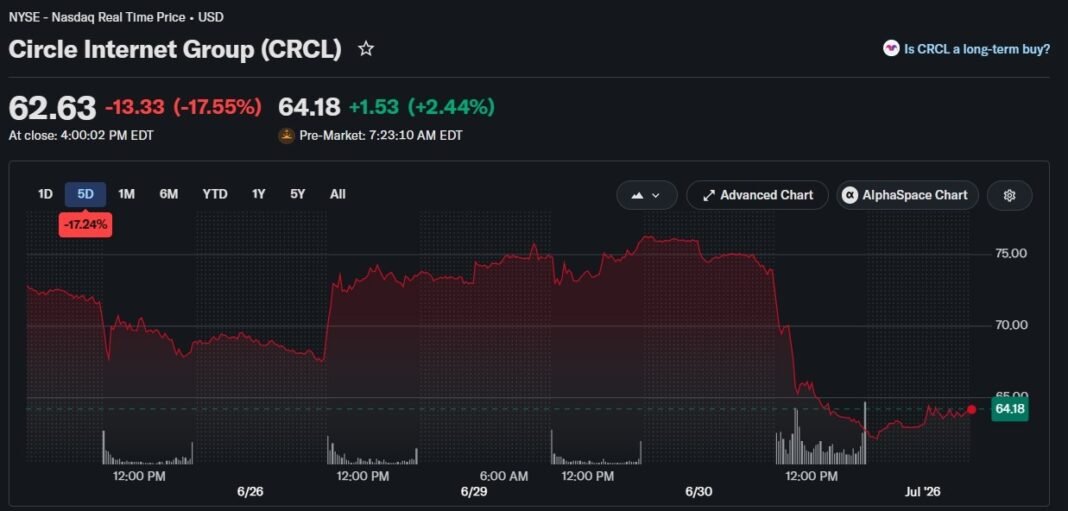
Circle’s stock performance in the last five days. Source: Yahoo Finance
Circle shares closed Tuesday at $62.63, down 17.55% from the previous session, before rising 2.44% to $64.18 in premarket trading as of 11 am UTC on Wednesday, according to Yahoo Finance data.
OUSD could challenge the Circle-Tether duopoly: Bernstein
In a research note, analysts at Bernstein said OUSD could become the “strongest and first new entrant to challenge the duopoly of Circle and Tether,” citing its reach across payments, banking, technology and commerce.
However, Bernstein said governance, operational architecture and the revenue-sharing formula remain open questions, as coordinating more than 140 partners will require substantial work. Bernstein said Circle spends close to $500 million on marketing, infrastructure, technology and compliance, highlighting the amount of resources needed to scale a stablecoin network.
Related: MetaMask launches stablecoin yield account with card spending
Lorenzo Valente, director of research at ARK Invest, took a more skeptical view. In a post on X, Valente said that OUSD still faces the cold-start problem created by USDC and USDT’s entrenched liquidity across the crypto ecosystem. He called the announcement a “giant” letter of intent and said that many participants also support competing stablecoins or operate their own infrastructure.
“The partners are backing rivals: Stripe owns Bridge and has its own stack, Coinbase is wedded to USDC, banks are building their own deposit tokens and the card networks support every token out there,” Valente wrote.
Magazine: Japanese pension fund tips 1% in crypto, G7 urges action on NK hackers: Asia Express