
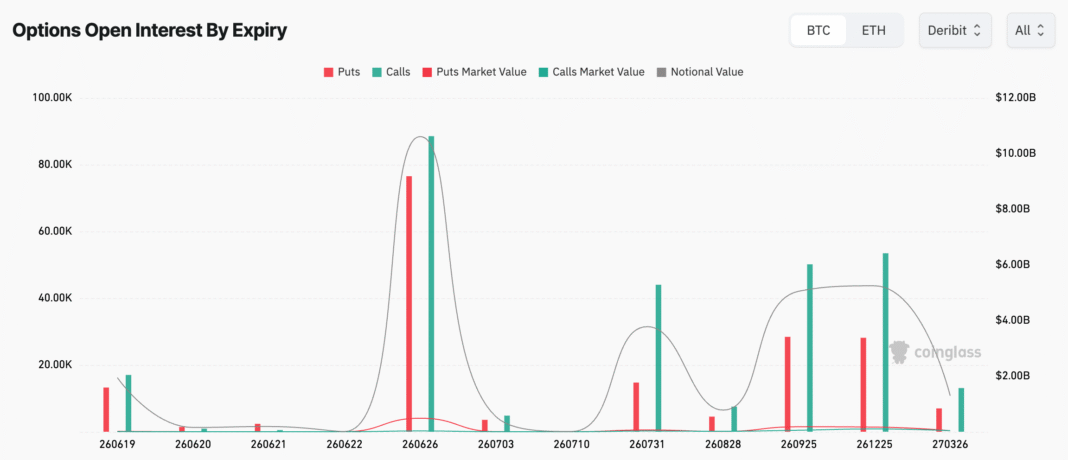

Bitcoin dropped below $60,000 by mid-June after a punishing start to the month, but the figure drawing the most attention across trading desks is the June 26 Bitcoin options expiry, with over $10 billion of contracts set to expire and roughly 80% currently sitting out of the money.
In equity markets, zero-days-to-expiry options now make up well over half of daily S&P 500 index options volume, up from around 5% in 2020.
Those two numbers come from very different corners of finance, but they describe the same underlying development: an options trading boom that has pushed contracts on what assets might do next into the most active part of modern markets, while ownership of those assets has slipped into a supporting role.
Finance as we know it is drifting from an economy built on ownership toward one built on optionality, where investors place a growing premium on flexibility, asymmetric payoffs, and exposure to probability itself.
Options, perpetual futures, prediction contracts, and tokenized derivatives are now the instruments through which markets discover prices and route capital.
Crypto reached this point first, which is why the strongest evidence for the supremacy of options first appears in Bitcoin and Ethereum before it surfaces in traditional assets.
Is crypto the first truly options-led market?
The reason crypto was first to the options race comes down to how these assets are valued.
Bitcoin generates no earnings, and Ethereum pays nothing resembling a conventional dividend, so their valuations lean almost exclusively on expectations about the future. In that environment, the derivatives market took on the work of price discovery.
By 2025, open interest in Bitcoin options had grown to rival, and at times surpass, open interest in Bitcoin futures, a milestone that would’ve seemed strange only a couple of years earlier.
The bulk of that exposure now sits with BlackRock’s IBIT options and with Deribit, the venue that built the professional crypto options market. The year-end 2025 expiry was the largest on record, representing more than half of Deribit’s entire book.
The market is wary of the size of this market because of the way options feed back into spot prices. When traders buy and sell these contracts, the dealers on the other side hedge their exposure by trading the underlying asset, which generates real buying and selling pressure.
Through late 2025, Bitcoin spent weeks pinned within narrow ranges as dealer positioning bought dips near one strike and sold rallies near another. We see the same process as we head into the June 26 quarterly expiry, with the max-pain level near $74,000 sitting well above the roughly $65,000 spot price.
Gamma effects amplify moves, large expiries reshape behavior around specific dates, and the derivatives market now sets the spot price rather than tracking it. IBIT’s $40 billion options book shows how large this market can get on regulated American exchanges.
Traditional markets are developing these same characteristics. US-listed options volume reached 15.2 billion contracts in 2025, up 26% from a year earlier, with an average daily notional value of around $4 trillion. Retail participation, modest only a few years ago, now accounts for more than 30% of contract volume and clusters heavily in short-dated bets that offer cheap access to large potential upside.
Institutions lean on options to hedge everything from rate risk to equity exposure. Algorithmic strategies, which are usually shaped by machine-generated forecasts, need instruments that express probability distributions, and options are exactly that. Each of these forces reinforces the others, and together they keep pulling activity toward optionality.
An economy that prices possible futures
We’ve seen the same pattern spread well beyond conventional derivatives. Prediction markets, which let participants buy contracts that pay out based on real-world outcomes, saw a record $31.2 billion in trading volume in May, with industry open interest at around $1.3 billion.
In April, a federal appeals court ruled that the sports-event contracts traded on Kalshi’s exchange qualify as swaps under the Commodity Exchange Act, affirming the CFTC’s jurisdiction over them and placing prediction markets squarely within the federal derivatives framework.
That classification collapses much of the distance between betting on an event and trading an option on it. Kalshi recently closed a $1 billion round led by Coatue at a $22 billion valuation, with annualized trading volume reported above $170 billion, a sign that investors now treat probability itself as an asset class worth owning.
The nascent tokenization market is also looking for options. Tokenized real-world assets excluding stablecoins passed $32 billion in May, roughly tripling in a year, and the broader market clears $300 billion once stablecoins are counted.
The first wave of this technology tokenized money, and the second wave tokenized assets like Treasuries, which now hold more than $13 billion on-chain.
The third wave is beginning to tokenize optionality directly, in the form of programmable derivatives that can trade around the clock on tokenized equities, commodities, and credit. Over time, the derivatives layer built on top of these assets could grow larger than the assets underneath it.
All of this affects how everyone experiences markets. Institutions now allocate through optionality because it improves capital efficiency, limits downside risk, and makes hedging much easier, so ownership becomes just one form of exposure among several.
Retail investors, even the ones who never trade a single contract, find themselves in markets where price swings around major expirations and dealer positioning can outweigh fundamental news.
Some caution is warranted here, since gross options volume is not the same as net dealer exposure, and much of the total RWA still reflects issuance rather than active secondary trading. The direction of travel, though, is consistent across every one of these markets.
The defining financial innovation of the past generation was the democratization of ownership through ETFs, online brokerages, and digital assets that let almost anyone hold a piece of almost anything.
The defining innovation of the next generation looks like the democratization of exposure to probability, the ability to take a position on what might happen without committing to what already exists.
Ownership built modern finance, and the appetite for options is shaping the chapter that follows, as the fastest-growing thing investors buy becomes the right to be right about the future.